Awake! by Anthony Gibbins

On this page we learn that Miranda is sleeping through a large part of the day because she has to work throughout the night. Why might that be...?

Miranda sleeps through a large part of the day because it is necessary for her to work through the night. Soon she wakes up (expergiscitur) and rises.

Or rather... by Anthony Gibbins

immo is another interesting word. It is a particle that may begin a sentence to indicate that the sentence corrects something that has come before. It may be used to completely negate what was previously said, to correct one part of a previous claim, or to supply a more precise version of a stated fact (among other things). Here immo corrects the idea that everyone is awake with the more precise 'everyone except Miranda'.

There are two other interesting expressions. The first is multum in diem which means late into the day. I've only seen it as multam in noctem, such as in Cicero's Dream of Scipio, where Scipio stays up late chatting with an old family friend. But I see no reason for not using it here. Speaking of Cicero, he also supplied somno se dare, 'to give one's self to sleep'. More poetic than simply repeating Miranda dormit.

Miranda, our title character, is seen here for the first time. I wanted to show off the fold-out bed that comes built-in to this apartment. The pyjamas and sleeping face come from a minifigure in the series 6 collection called Sleepyhead. He is quite expensive to buy on eBay, but I found one in Germany going cheap because he had no hair. I didn't need the hair, so problem solved. It does mean, however, that everyone in Legonium probably owns the same pyjamas.

Or rather, everyone except Miranda. Miranda is still seeping in her bed. Perhaps you are asking why Miranda gives herself to sleep so late into the day.

quota hora est? by Anthony Gibbins

English does not have an equivalent of the word quotus, quota, quotum, which means 'having what position in a numerical series'. In Latin we use it with the noun hora to ask the time; quota hora estThe answer to which is not three o'clock, but the third hour; hora tertia est. 3:15 is hora tertia et quadrans. 3:30 is hora tertia et dimidia and 3:45 is hora tertia et dodrans. Three o'clock on the dot is hora tertia in puncto.

While we are talking about Latin and time, do you know the origins of the word minute and second? There is a Latin verb minuere which means 'to make smaller, to chop up'. So, the words hora minuta mean 'a chopped up hour'. The words hora minuta secunda mean 'an hour chopped up for the second time'.

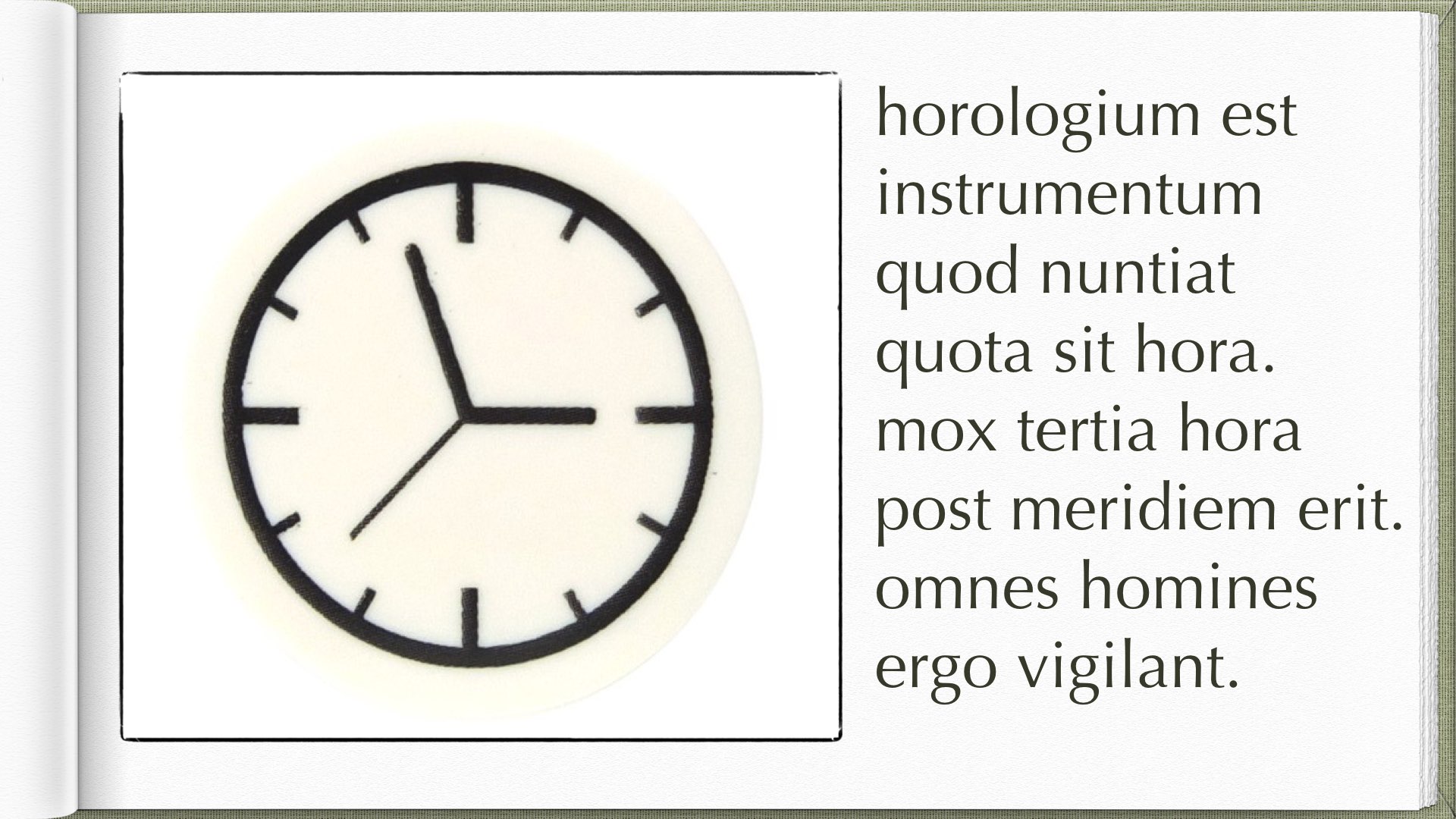
A clock is an instrument that announces what time (hour) it is. Soon it will be the third hour after midday. All people therefore are awake.

Augustus, administrator argentarius by Anthony Gibbins

The image of a bank employee up a ladder comes straight from the box art for this set. While a man scrubs away at the bank's clock, the bank manager is standing on the pavement trying to hand him an envelope. Very strange. In this image, it is the administrator argentarius himself doing the heavy lifting. For whatever reason, our Augustus, whom I assume to be a very busy man, can be found in the middle of the afternoon up a high ladder ensuring that the town's timepiece sparkles in the sun.

argentarius is an adjective meaning 'of or concerned with silver; monetary, financial, pecuniary, concerned with banking'. It is also used as a noun in the masculine meaning 'banker'. It comes, of course, from the Latin word for silver, argentum, which gives us both its chemical symbol - Ag - and the name Argentina, from the belief that the region was rich with that metal. I will translate administrator argentarius as the rather prosaic 'bank manager'.

Do you see Augustus? Augustus is the bank manager. At this time (ablative of time when) Augustus is standing on a high ladder, washing the clock.


aedificium magnificum by Anthony Gibbins

I have already had quite a bit to say about the Brick Bank, but here you can see the building in all its Lego glory. If you look closely, you can see the little laundrette in the bottom right hand corner. I struggled for a bit as to what to call the laundrette, and I'm still open to suggestions. So far I've settled, as you can see, on lavatrina vestimentorum. There is a little pun on the word 'launder' built into the Brick Bank modular. Within the bank itself is a safe with a series of safety deposit boxes and withIn the laundry are four washing machines. One of the washing machines is marked out of order, and if you throw any gold, coins or notes into the broken machine, it appears (through an ingeniously hidden Lego slide) in one of the safety deposit boxed, successfully laundered. A physical pun.

On the corner, where two streets meet, stands this magnificent building. This building contains a bank and a small laundry.

in animo habere by Anthony Gibbins

Viewers of shows like Lost or Orange is the New Black will be familiar with the device of continuing an overarching narrative through a focus on individual characters. The novelisation of Game of Thrones provides another example. The title page of Legonium : pars secunda informs us that this part of the story will be told through the lens of Miranda.

But first, our narrator is back. I have always liked the expression in animo habere - to have in mind, to intend. Here are just a few of the definitions of animus found in the Oxford Latin Dictionary; the mind as opposed to the body, the mind or soul as constituting with the body the whole person, the immortal part of a person, the spirit or soul of the universe, the mind as the seat of consciousness, the mind as an organ of thought, judgement, memory and opinion, the mind as the originator of intensions.

pergo, pergere, perrexi, perrectum to continue, proceed, go on with is a very handy verb indeed. It can be used absolutely (in Macedoniam), with an accusative object (iter) or with an infinitive (explicare).

Hello reader. It is a joy for me to see you again. I have in mind to continue my story. Do you wish to hear more?

a sneak peak @ lego audio disco by Anthony Gibbins

I want there to be a place on Legonium where a complete beginner can come to learn Latin. It is my hope that lego audio disco – I read, I listen, I learn – will evolve to be that place.

There has been much talk in Latin teaching circles that the 19th-20th Century ‘grammar explanation’ method of Latin teaching is not the only – or indeed perhaps the best – option available to us as educators.

lego audio disco will experiment with that idea. Each lego audio disco lesson will consist of two videos. The first will contain sentences and phrases (illustrated with Lego, scilicet) repeated three times; first in Latin, then in English, then in Latin again. It is my assumption that if the introduction of new material is carefully handled, the learner should be able to follow the meaning of the Latin sentences and deduce something of the grammatical rules. The second video contains only the Latin, and the learner can test their understanding by watching the video entirely in that language, hopefully without any internal English dialogue.

The videos are currently without any audio, but a terrific colleague, Phillip S., will soon be recording narration. This will ensure that the learner hears correct pronunciation from the very beginning while having the Latin reinforced through the aural receptors. Phillip has, mea sententia, an exceptional clarity of voice and I am both grateful and excited for his involvement.

Please, if you have a moment to watch the videos, I would be very appreciative of any feedback.

Oh, and one final thing. I am investigating the possibility of having a version of each lesson available as an ibook (sine voce). This would allow the learner to move back and forth through the ‘video’ at their own pace.

pars fabulae prima perlecta est by Anthony Gibbins

Thank you to all who have read through the first part of Legonium with me. I am trilled with how well readers have responded to this project and, mea sententia, the best is still to come.

Tomorrow I will be posting the first lesson of lego, audio, disco - a Legonium course for complete Latin beginners. I hope you will check it out and give me your feedback. Until then, here is today's translation;

I hope that my story is pleasing to you. The story, however, is not yet completed, therefore it will be necessary for me to soon tell more of the story. Be well!